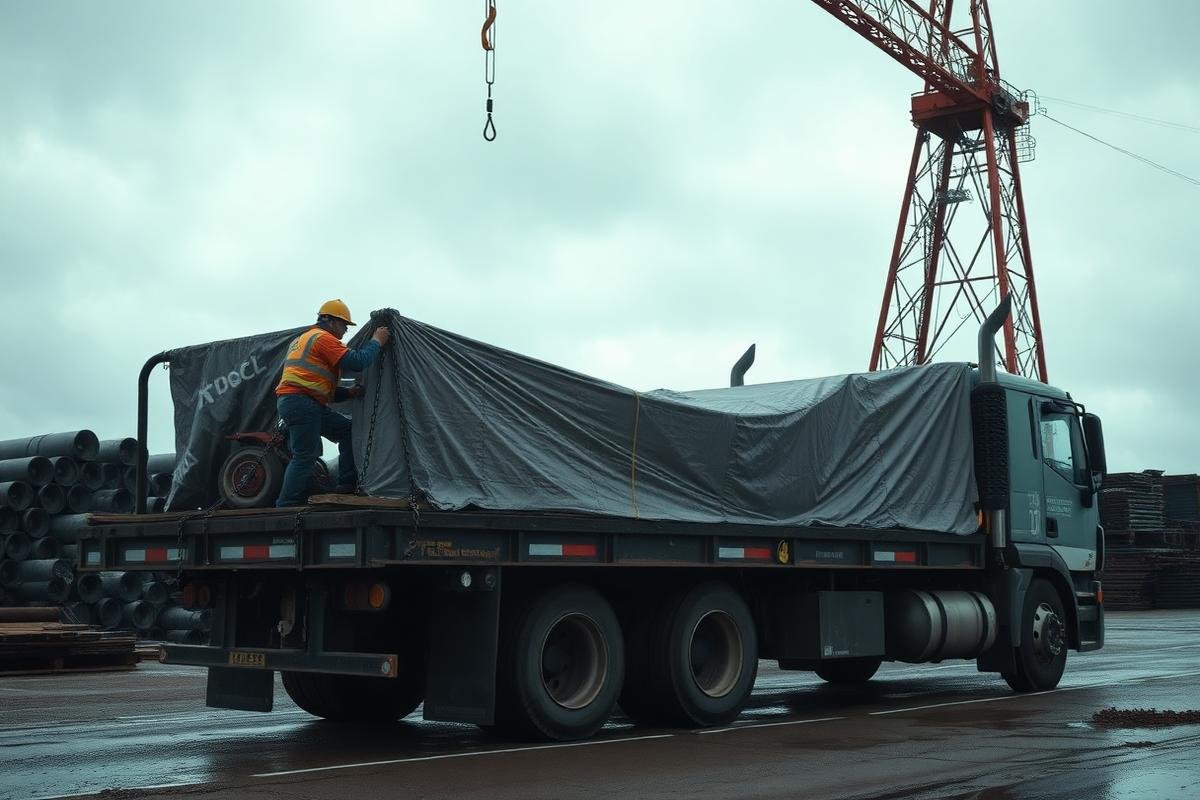
Flatbed pays better than dry van for a reason: the load is your responsibility in a way that a sealed trailer never is. The good news is that securement is a checklist, and a checklist run the same way every time takes fifteen minutes.
Before the load touches the deck
- Walk the deckSweep debris, check every stake pocket and rub rail, and look for cracked welds. A pocket you cannot trust is a strap you cannot count.
- Inspect working load limitsTag-check straps and chains. Anything with a cut edge, a knot, or an illegible tag comes off the truck, not onto the load.
- Lay dunnage firstSet 4x4s or rubber before the forklift arrives. Retrofitting dunnage under a loaded coil is how backs and fingers get hurt.
The math you have to be able to recite
- Aggregate working load limit must be at least half the cargo weight.
- One tiedown for articles up to 5 feet and 1,100 pounds; two for anything longer or heavier.
- Add one tiedown for every additional 10 feet of length, rounded up.
- Edge protection anywhere webbing crosses a corner — no exceptions, no exceptions later.
Tarping without wrecking the load or your shoulder
Tarp only what needs tarping, and tarp it in the same order every time: bows or corner protection first, steel tarp over the front, lumber tarp over the rear, overlap facing rearward so airflow closes the seam instead of opening it.
Bungees are the failure point on most tarp jobs. Use rubber straps rated for the job, spaced no more than four feet apart, and never hook into a strap you are relying on for securement.
The re-check cadence that keeps you legal
| Checkpoint | What you are checking | Time |
|---|---|---|
| Within 50 miles | Initial settle, strap tension, tarp seams | 5 min |
| Every 3 hours or 150 miles | Tension, chain binders, edge protection | 5 min |
| Every duty-status change | Full walk-around, tire and light check | 8 min |
| Before any scale | Tag legibility, count, tarp flap | 3 min |
Log the checks. A driver who can show the re-check pattern in the log has a very different conversation at a roadside inspection than one who cannot.
- 50%Minimum aggregate working load limit vs cargo weight
- 50 miFirst mandatory re-tension checkpoint
- 15 minFull pre-departure run when it is a habit
Questions operators ask
Do I need edge protection on chains too?
Can a dispatcher help with flatbed loads?

armdcat@gmail.com
All articles by this author